Chair Trap
Furniture Design, Mechanism Design
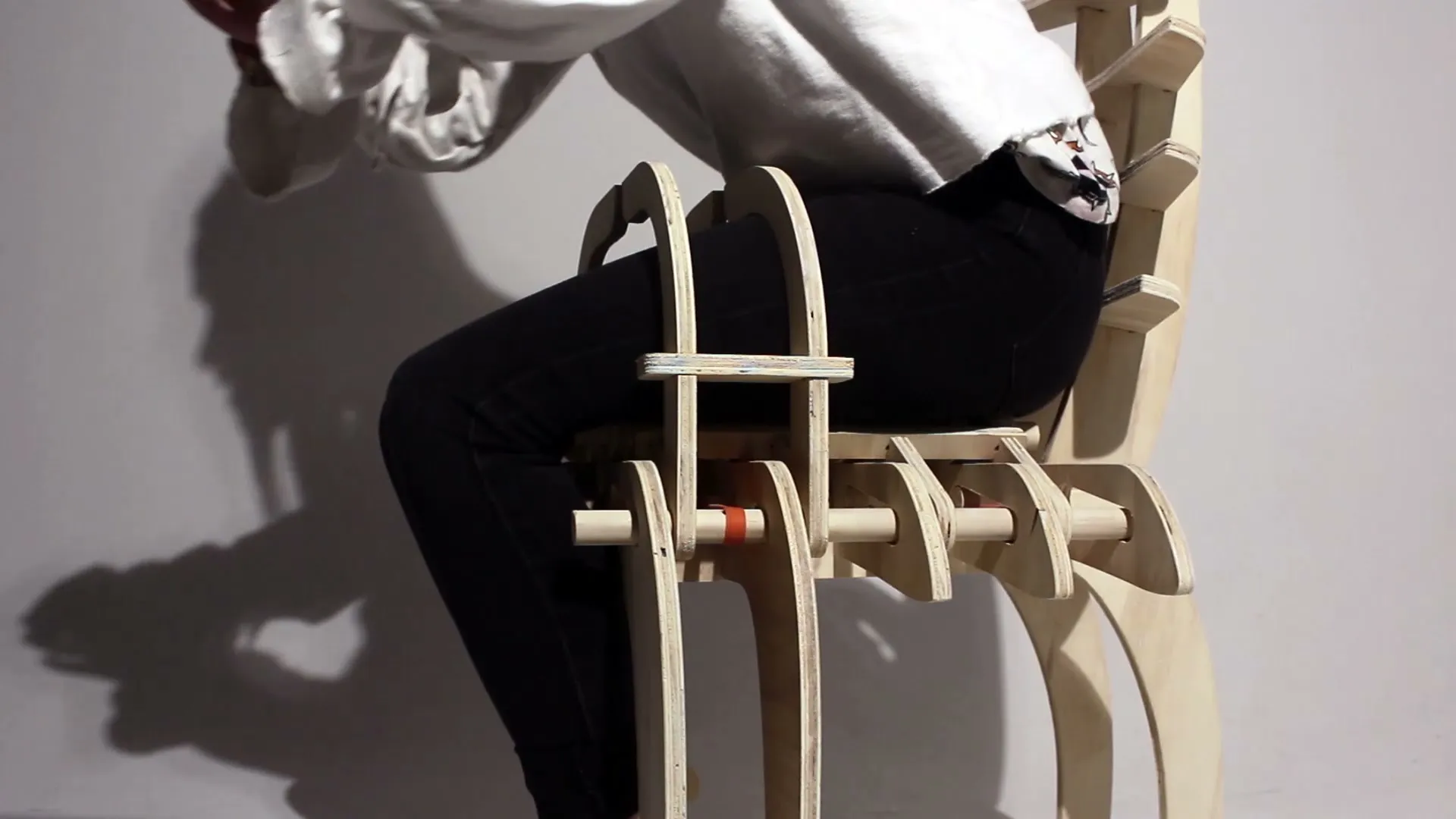
A plywood chair built as a mechanism rather than a fixed form: sitting down drives a linked set of pin-jointed ribs that spread and close around the sitter. Nothing in it is rigid, so it has no settled shape until someone sits down.
- Drawing title
- Sheet 04-08
- Organisation
- Role
- Year
- Location
- Sector
- Status
Background
INDN 241, Tangible Creation. The brief was to design an object that physically supports part of the body and provokes a visual or tactile response in the person using it.
What I built
A chair with no fixed backrest. The seat is a stack of dowel-jointed plywood slats that sits folded flat when empty. Two curved ribs either side act as arms, and a tall fan of horizontal slats stands behind the seat on two vertical spines.
None of those joints is rigid. All of it is pinned, so the whole assembly is one linkage rather than an assembly of parts: sitting down loads the seat stack, that load travels through the shared joints into the side ribs and the rear fan, and the chair opens around the person sitting in it. Let go and it closes again. The body is not operating a control, it is the input.
Outcome
What the mechanism argues is a reversal of the usual bargain. Nearly every chair is a fixed shape a body adapts to; this one moves instead, so the adapting happens on the chair's side. The "trap" in the name is that reversal, not a warning.
It is also the least practical thing here, and worth keeping for that. A chair that reshapes itself under load is a bad chair and an extremely clear demonstration of a linkage, which is what a second year course should be producing.