08 / 15ToolsData Automation / Quality Assurance / Information Management2025
Automated Document Compliance
Two FME workflows that audit an entire project document register: 17 information standards applied to every document in the CDE, then 13 further checks against the TIDPs. The first run flagged over 600 non-compliant documents, 100 duplicate TIDP entries and 3,000 unmatched codes, in under a minute.
FME
AutomationComplete
- Organisation
- Role
- Year
- Kind
- Sector
- Location
- Status
Background
Manual review of hundreds of documents, TIDPs and codes against BIM standards was time-consuming, inconsistent and error-prone. Missing codes and mislabelled files slipped through routinely, and the effort scaled directly with document count.
What I built
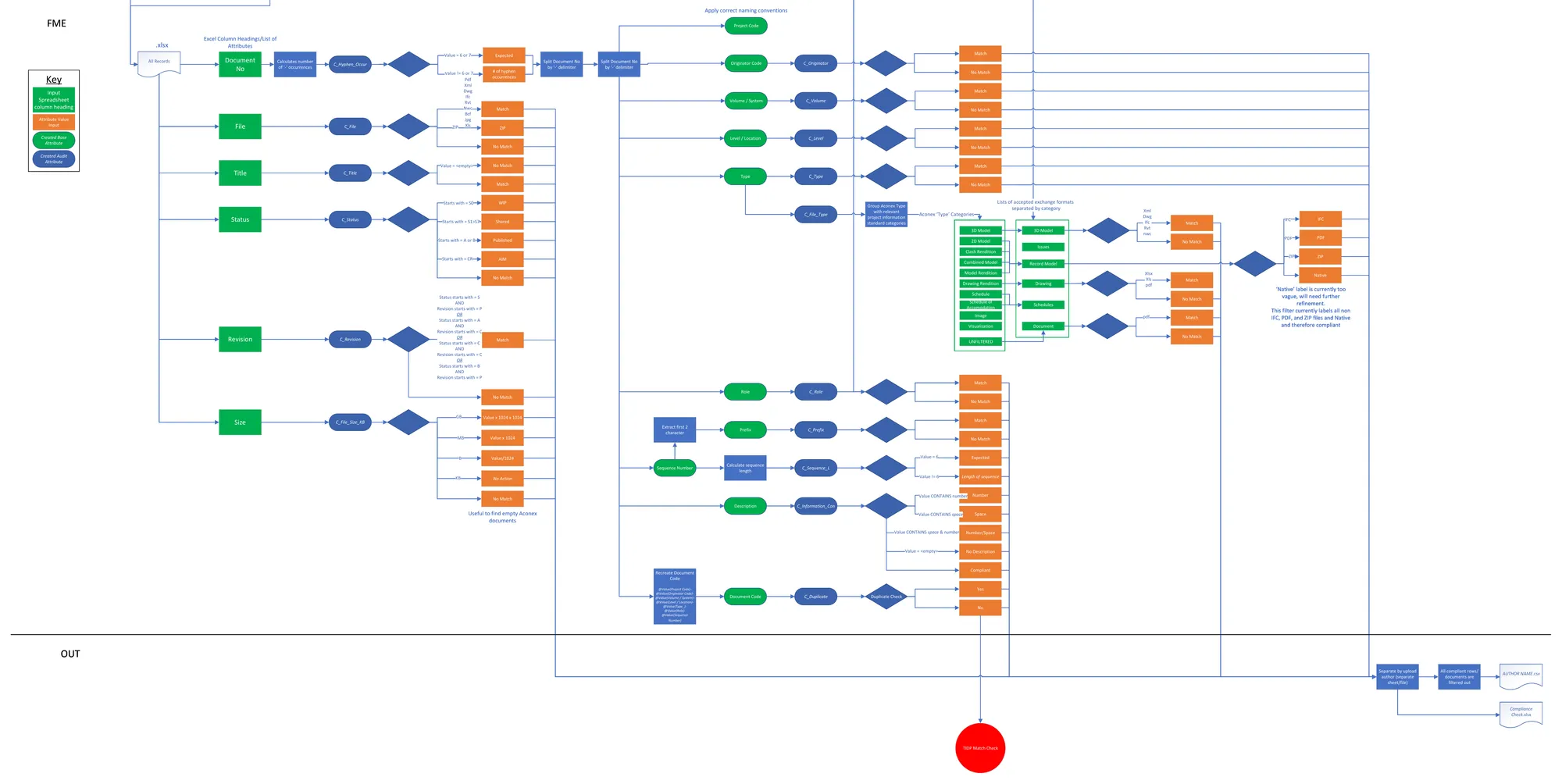
Document Validation Workflow. Checks every document in the CDE, held in Aconex, against 17 project information standards covering file naming conventions, revision codes and file formats. Generates a comprehensive Excel report grouped by author, highlighting non-compliant documents, missing or incorrect codes and duplicates.
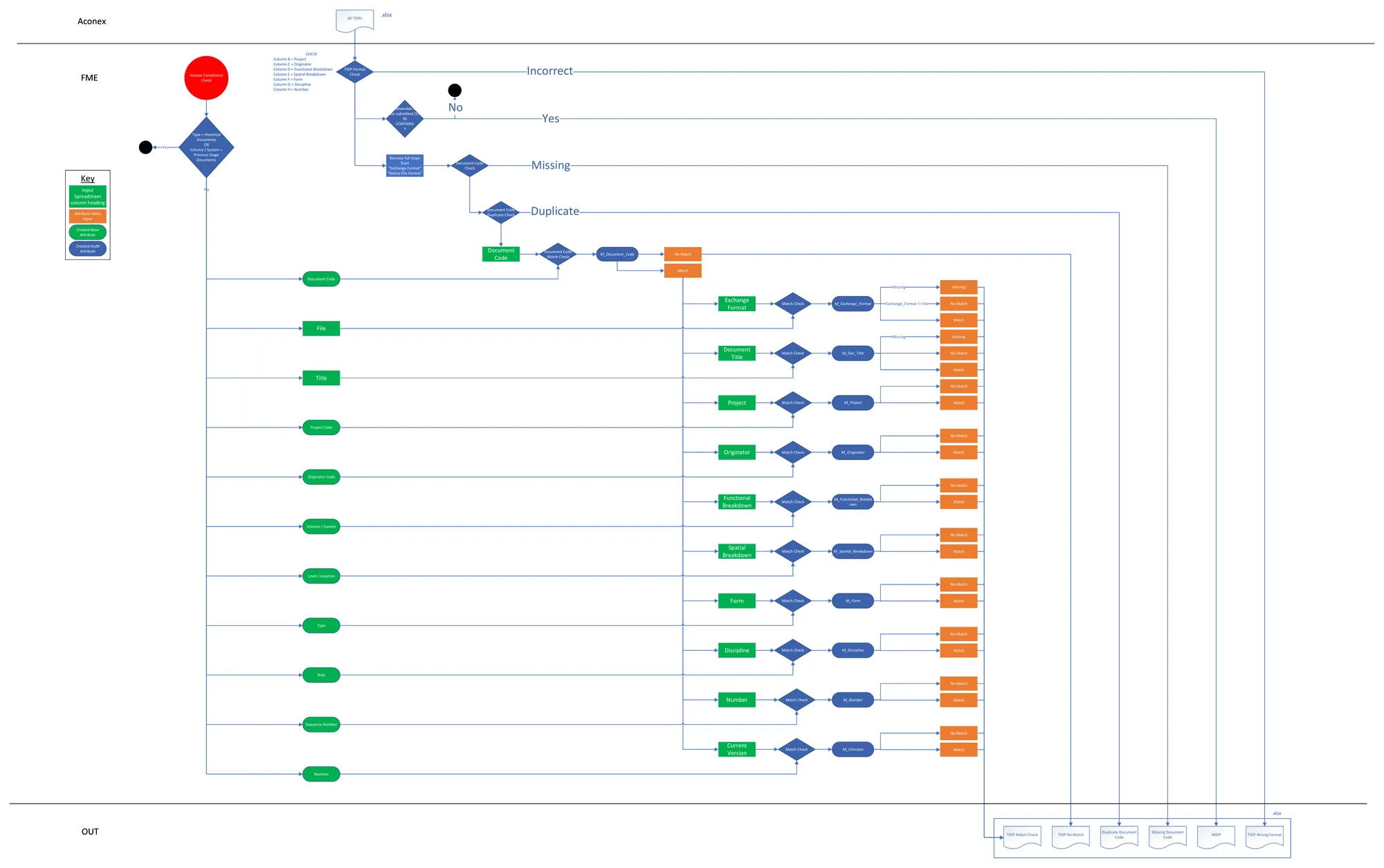
TIDP Comparison Workflow. Examines all non-duplicate documents and cross-references them against the project Task Information Delivery Plans, running 13 further compliance checks, producing a detailed breakdown report and automatically generating an updated MIDP.
Outcome
On its initial run the system flagged over 600 non-compliant documents, identified 100 duplicate TIDP entries and detected 3,000 unmatched codes, in under a minute.
Those are errors that would otherwise surface at audit or handover, which is the most expensive point in a project to find them. Running the check continuously moves that cost to the start, where a wrong document code is an edit rather than a re-submission.
Co-developed with a colleague in information management, who provided domain expertise, refined data formats and improved the reporting templates. Rated Level 3, Novel Application, on the internal innovation scale, and recognised with a Special Mention in the Optimisation category of the VINCI Group Innovation Awards.
Where it goes next
Built for Meridian Water but designed to be adapted to any project by swapping the rule sets to match that project's information standards.
Tools and disciplines
- Built with
FME
- Discipline
Data AutomationQuality AssuranceInformation Management