02 / 04ObjectsRobotic Fabrication / Computational Design / Materials Research2021
Summer Research Scholarship
Three months of solo research putting plasma bonding on a robot arm to strengthen spatial 3D printing. Two test jigs and two torch holders designed for an ABB IRB 1200, bonding parameters characterised across three filaments, and TPU bonds that outperformed the strongest PLA bonds from the previous studies.
RhinoGrasshopperHAL RoboticsABB RobotStudio
Made objectComplete
- Organisation
- Client
- Role
- Year
- Kind
- Sector
- Location
- Status
Background
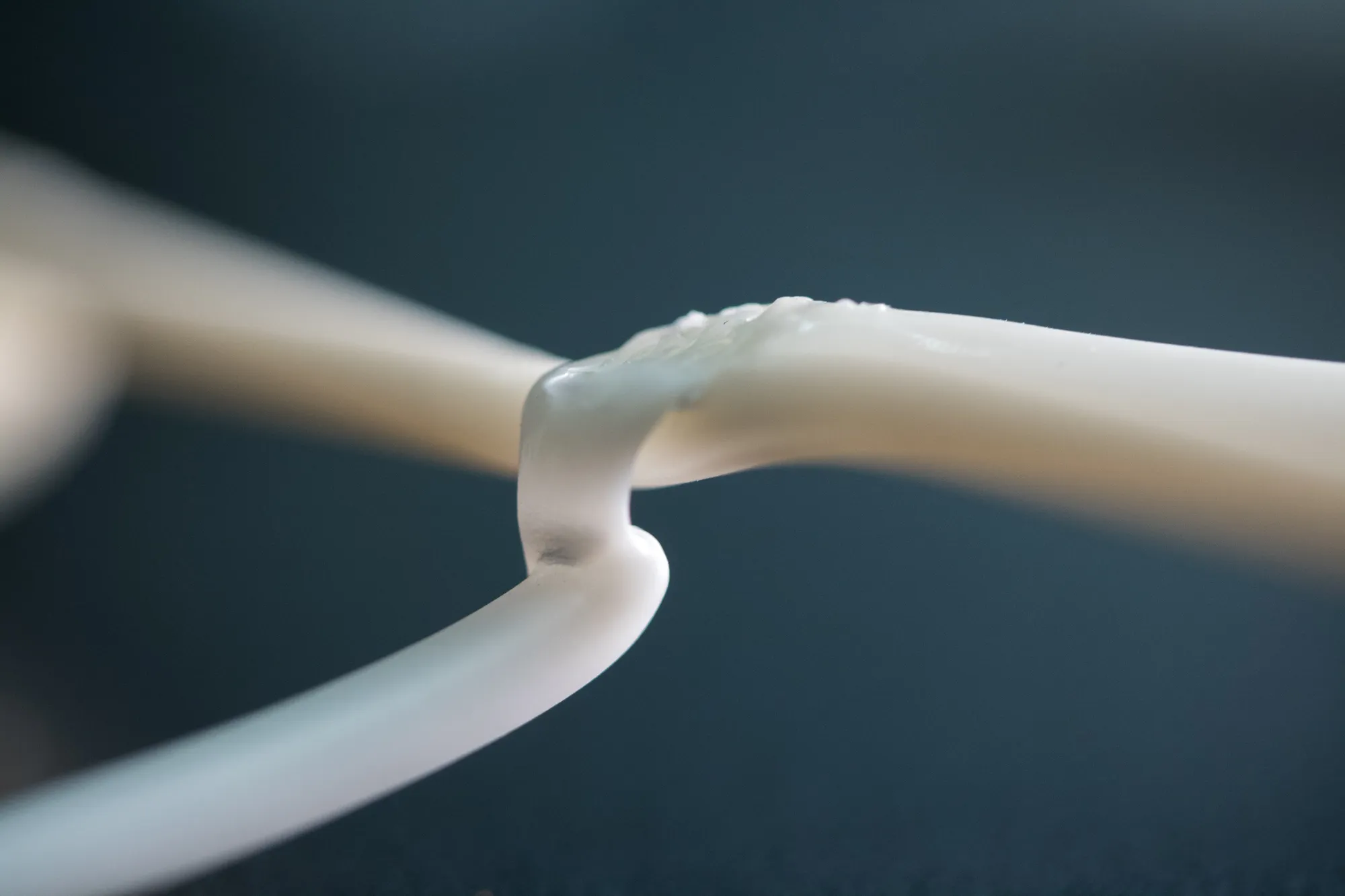
Spatial printing builds freeform structures in mid-air rather than in layers. The weak point of the technique is the bond between filament paths, which limits what the resulting structure can carry. Victoria University of Wellington had investigated plasma treatment as a way to strengthen those bonds in previous summer scholarships.
This project ran December 2020 to February 2021 under a supervisor at VUW and a co-supervisor at GNS Science, with materials and additional research support from Scion and the University of Waikato.
The problem
The uncoiling extrusion method developed in prior VUW research applied plasma bonding manually. To produce anything at scale, the bonding had to move onto a robotic arm with repeatable placement, and the process parameters had to be characterised well enough that a Grasshopper definition could generate paths a robot could actually execute without collisions or singularities.
Two open questions blocked that: how to hold the plasma torch on an ABB IRB 1200 end-effector with adjustable accurate positioning, and how PLA filament's shape memory would interact with a technique where the filament is placed by uncoiling rather than extrusion.
What I built
Two purpose-designed test jigs and two plasma torch holders, iterated through the project as the constraints of each technique became clear.
Test Jig 1.0 clamped filament between three 3D printed parts with M5 bolts, secured to the table with double-sided tape and shielded from the plasma torch with an MDF slip. Sufficient for recreating manual bond tests under robotic control.
Test Jig 2.0 used four removable, replaceable filament-mounting sections separated from independently secured wooden reference blocks, so the jig itself could be lifted out and reset without recalibrating the robot. This was the switch that made systematic multi-bond testing viable.
Plasma Torch Holder 1.0 attached to the end-effector without modification, with three independent adjustment points. Sufficient for the initial pressing-nozzle geometry.
Plasma Torch Holder 2.0 repositioned the torch parallel to the filament join axis with two adjustment joints, letting the focal point be moved by a single position rather than three. This was required once the failure mode shifted from bad torch aim to uneven melt between the top and bottom filaments at the intersection.
The whole system ran on the ABB IRB 1200 with HAL Robotics for Grasshopper as the programming layer, so path generation and robot control lived in the same parametric environment as the design.
How it works
Testing worked through three filament materials in sequence.
PLA, 2.75mm. Filament memory dominated. Structural filament had to be de-memoried with a heat gun before every test, or it would spring back and drag the laid filament out of position mid-bond. Even after this, PLA's stiffness meant every direction change kinked the laid filament at the bond, creating a weak point. The reversed-tipping torch angle in Plasma Torch Holder 2.0 helped, but the material was fighting the technique.
TPU, 2.75mm. Roughly ten times more forgiving. A distance of 20mm at 8 seconds sat in a wide sweet spot, plasma air pressure caused less filament displacement, and shear resilience appeared qualitatively better. This became the working material for the rest of the project.
Scion thermo-chromatic filament, 2.5mm. Melted faster and at lower thresholds, requiring 3 to 4 seconds rather than 8. Demonstrated the technique generalises beyond a single material.
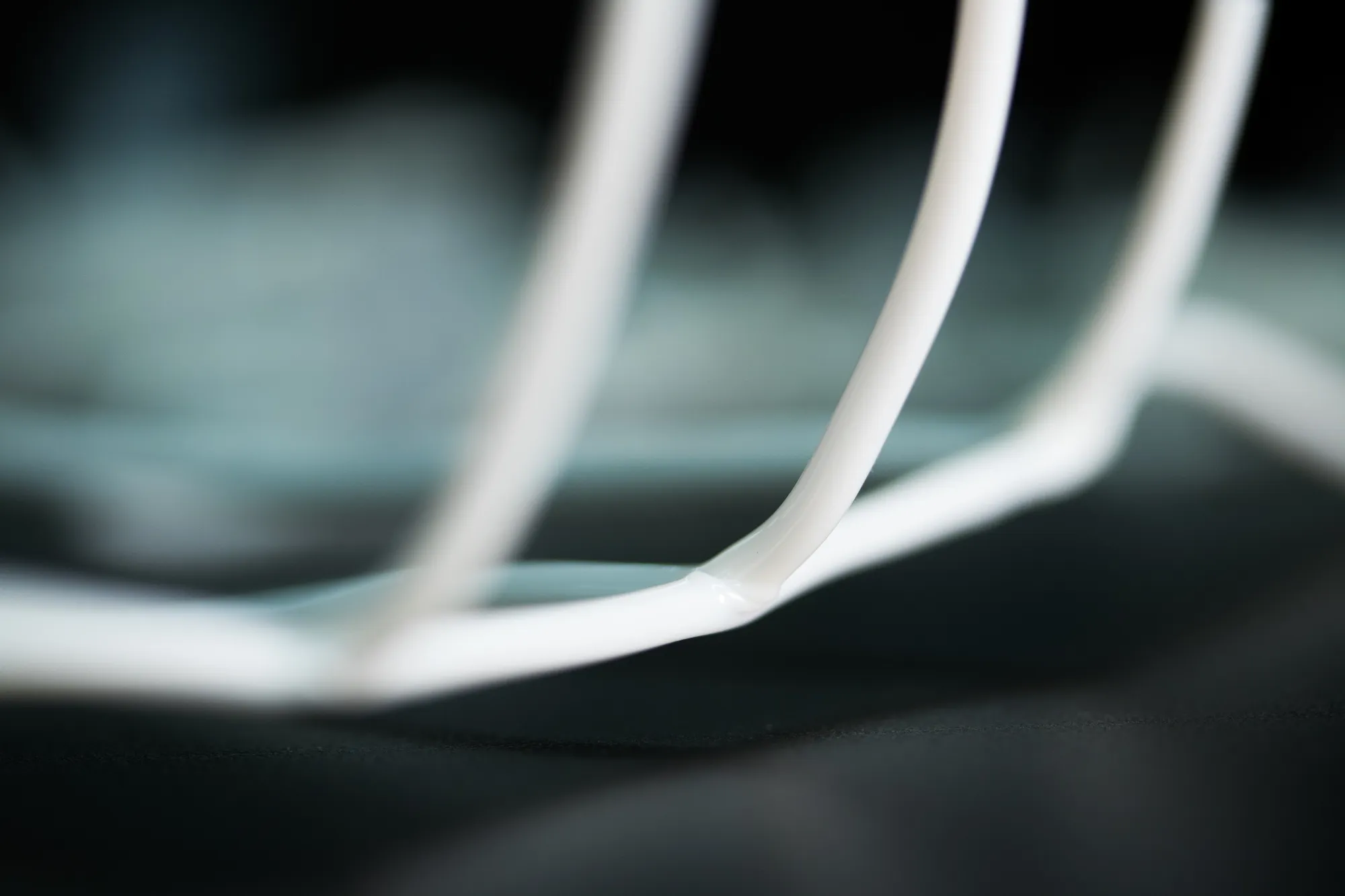
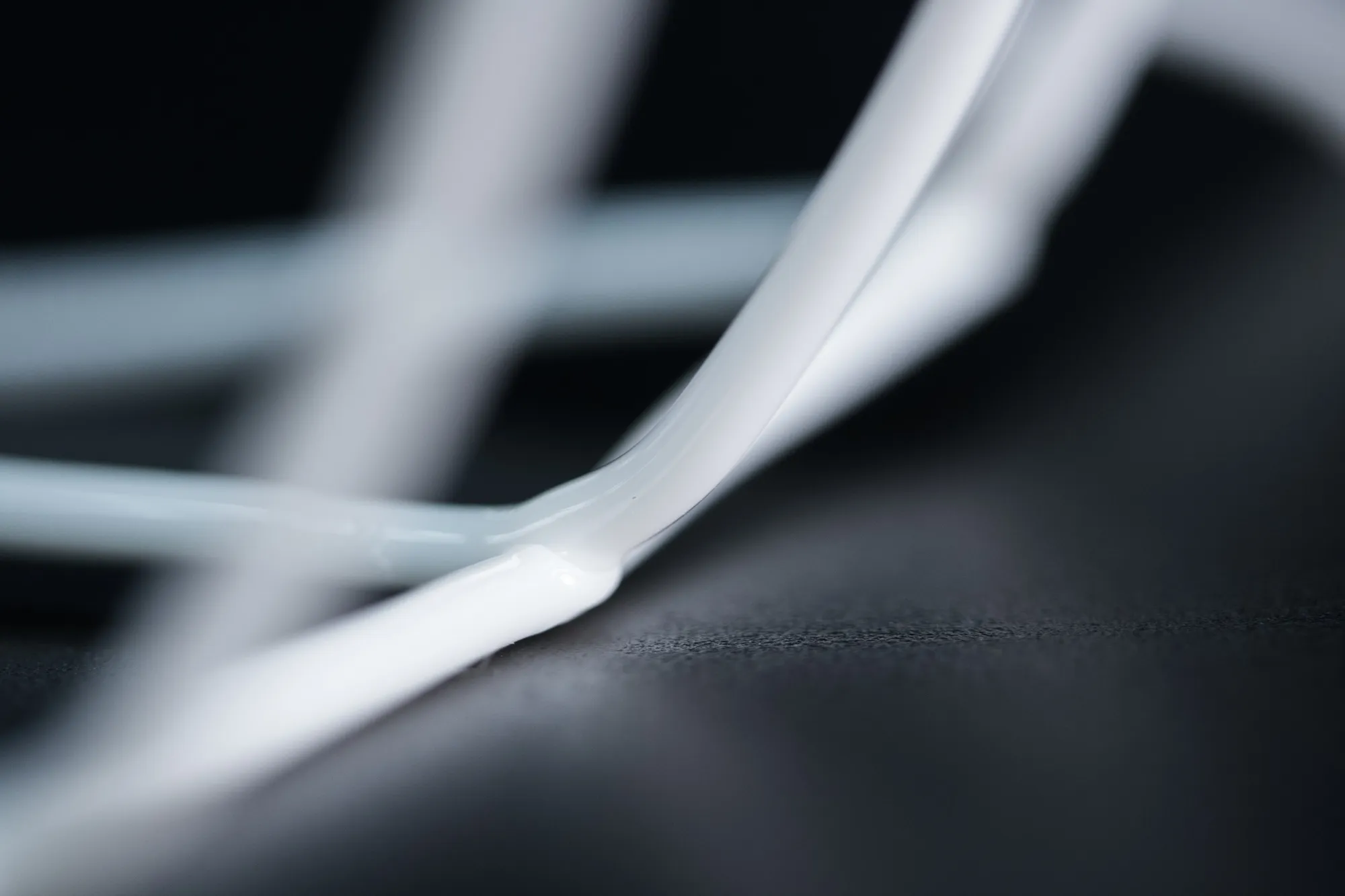
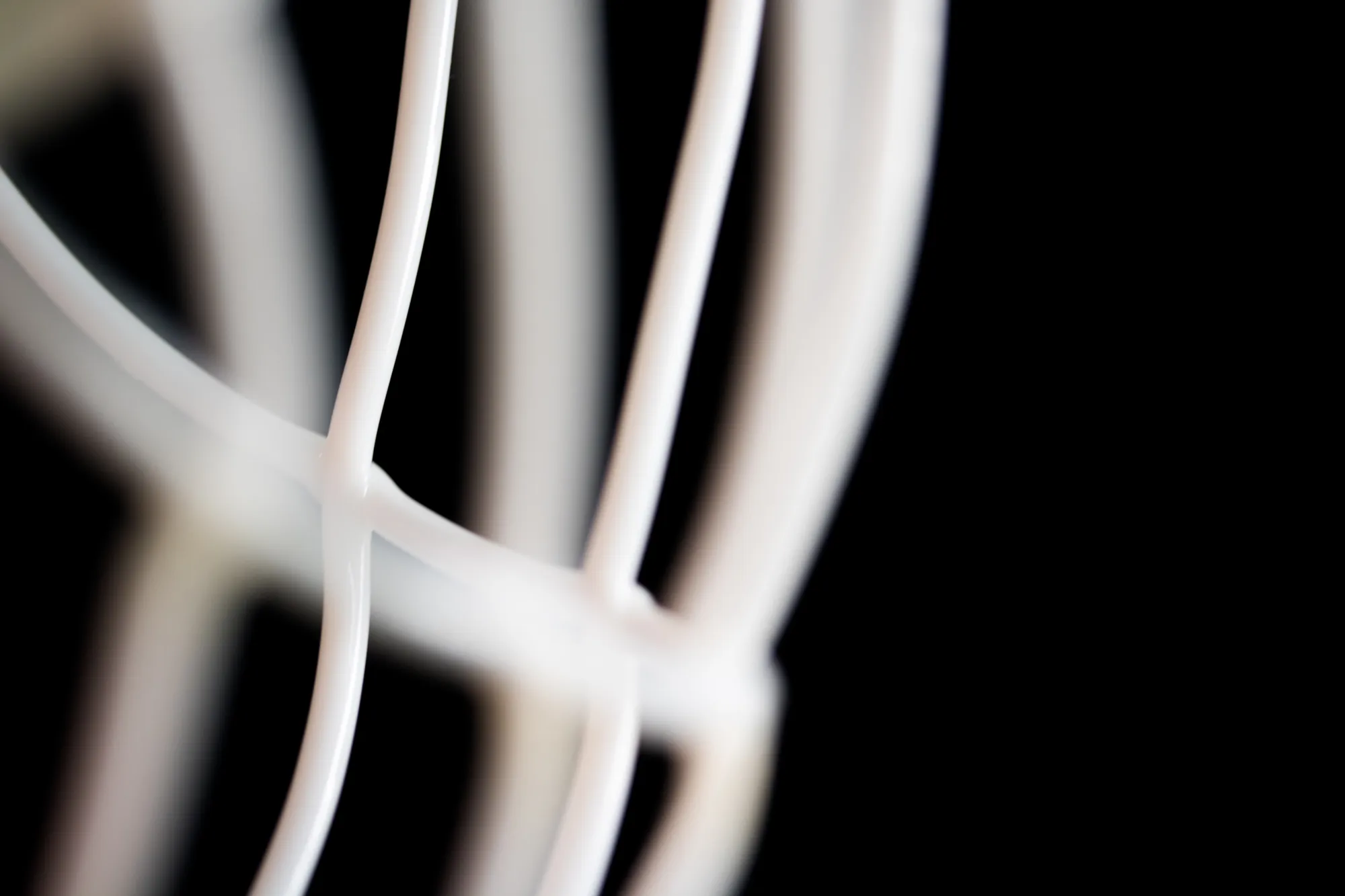
Once TPU parameters were locked, more complex patterns were tested: continuous zig-zag geometry between two structural strands, mesh structures where the torch stayed on across non-bonded intersections, continuous parallel joins between two laid strands, and mid-air filament reorientation using continuous plasma during rotation, which turned out to be the mechanism that made sharp bond turns viable.
Outcome
Tested on the MARK-10 Motorised Tension and Compression Stand.
- TPU bond at 4 seconds: 69N
- TPU bond at 5 seconds: 103N
- TPU bond at 8 seconds: 131N
- Previous years' strongest PLA bond: below the 4-second TPU result
Every TPU bond outperformed every PLA bond ever produced under the same testing regime, tension force only. Bond deformation typically began at around 20N and the material stretched substantially before failure, indicating strong shear resilience alongside the tensile figures.
Combining robotic fabrication, plasma bonding and computational design tooling in a single Grasshopper-driven workflow is unusual even in academic research, where the three disciplines are more commonly pursued separately.
Where it goes next
The technique is documented and characterised, and the next step is scale. The ABB IRB 1200's small working envelope meant complex forms hit joint singularities and collision constraints regularly. Moving to a larger arm removes both, and would let the zig-zag and mesh work extend into real structural geometry rather than sample pieces.
PDF, 101 pages, 10MB. Typeset and laid out as the submitted report.
Tools and disciplines
- Built with
RhinoGrasshopperHAL RoboticsABB RobotStudio
- Discipline
Robotic FabricationComputational DesignMaterials Research